

Cross-border driving is some of the best work in Canadian trucking: long, steady runs, real miles and a pay cheque that reflects them. It also asks more of a driver than a provincial run does. You carry two countries’ rules in your head, you need documents that let you cross every week, and the border sees you more often than any roadside inspector. Here is what the job really takes, whether you are new to the AZ or a provincial driver thinking about going south.
In short
- You need an AZ licence (Class A with the Z air brake endorsement), a clean record, and a passport or FAST card.
- In the US you drive under US hours-of-service rules, US drug and alcohol testing, and roadside English checks.
- Before you sign on, ask how border waits, detention and layovers are paid. They separate good cross-border jobs from bad ones.
The licence: AZ
An Ontario AZ is a Class A licence with the Z endorsement for air brakes. New Class A drivers must complete Mandatory Entry-Level Training (MELT) before the road test, and the Z endorsement takes its own knowledge and practical tests. Under the Canada–US reciprocity agreement, a valid Canadian commercial licence is accepted in the US. A few medical conditions that a province can waive aren’t accepted south of the border, though, so if your licence carries a restriction, ask before you apply for cross-border work.
Border documents
Every crossing checks who is driving:
- A passport or a FAST card. The FAST card is the trusted-traveller card for commercial drivers, issued after a background check and an interview with US and Canadian border officers. It lets you use FAST lanes, which are often much shorter than regular lanes, and it is a valid travel document for land crossings. Our FAST program guide covers how drivers enroll.
- A record that clears both countries. A criminal record can affect your admissibility to the US and your FAST eligibility. If you have one, sort out where you stand before you build a career on crossing.
The rules you’ll drive under
Driving in the US means following US rules on US soil:
- Hours of service. In the US you get 11 hours of driving after 10 hours off, not Canada’s 13, and the hours you have already driven in Ontario still count. Our hours-of-service comparison has the full rules side by side. Your ELD keeps the record on both sides.
- Drug and alcohol testing. Canadian drivers who operate in the US fall under US Department of Transportation testing. That means a pre-employment drug test, then random, post-accident and reasonable-suspicion testing, with violations reported to the FMCSA Drug & Alcohol Clearinghouse.
- English proficiency. US inspectors can check a driver’s ability to read and speak English at roadside, and failing can put the driver out of service. Our English proficiency explainer covers what is being enforced.
What a cross-border week looks like
Most cross-border work runs in loops: a southbound load from Ontario, one or more US deliveries, then a reload heading home. How smooth that week is depends almost entirely on dispatch. A good dispatcher has your next load lined up before you deliver the current one, books appointments you can legally make, and answers the phone when a receiver turns you away at 2 a.m. On reefer runs, the job also includes pre-trip checks on the refrigeration unit, watching the temperature, and keeping seal numbers and paperwork in order. Our protect-from-freeze guide shows why that matters in winter.
Questions to ask any carrier before you sign
- How am I paid? Per mile, hourly, or by load. Which miles count, and how often is pay issued?
- How are border waits, detention and layovers paid? On a cross-border job these hours add up every week.
- Is there a holdback on my first pay?
- What equipment will I drive, how old is it, and who maintains it?
- What lanes will I run, and how often will I be home?
- Will you help with my FAST card?
- Who answers the phone at 3 a.m.?
A carrier with good answers will give them quickly. A carrier that changes the subject has given you an answer too.
What Alpha Trans offers drivers
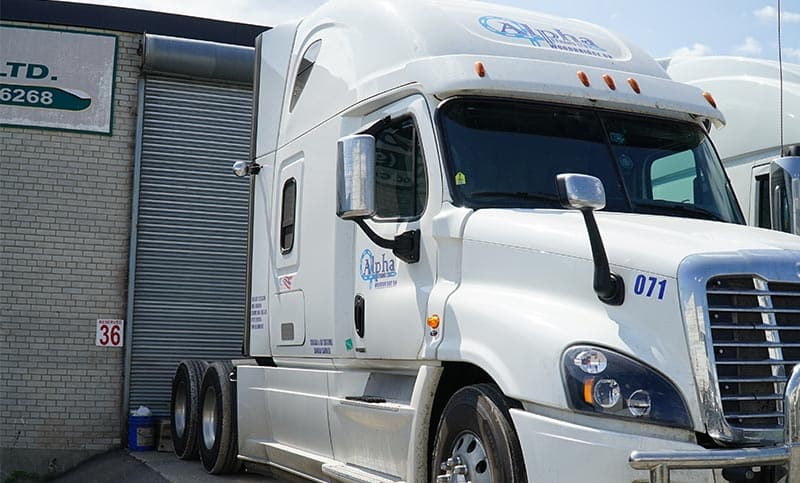
Alpha Trans has been family-owned since 2002, and our management knows our drivers by name. You drive late-model, company-owned tractors maintained in our own Brampton shop on a 15,000 km cycle, so there is no owner-operator risk on your shoulders. Highway drivers are paid by the mile and local drivers by the hour, every week, with no holdback on the first cheque. Our established lanes run from Ontario to ten US states, including California, Texas, Illinois and Arizona. We help with FAST card enrollment, and our dispatch plans your next load before you deliver this one. Someone answers the phone around the clock.
If you hold an AZ and want steady cross-border miles, see our driver jobs and apply.
Filed under Drivers & safety
Cover photo: 500photos.com via Pexels